Skincare Product MOQ Guide 2025: Complete Minimum Order Quantity Breakdown for OEM/ODM Manufacturing
Minimum Order Quantity (MOQ) is one of the most critical factors when launching a private label skincare brand. Understanding MOQ requirements across different product categories, manufacturing processes, and suppliers can save you thousands of dollars and months of delays. This comprehensive guide breaks down everything you need to know about skincare MOQs in 2025.

What is MOQ and Why Does It Matter?
Minimum Order Quantity (MOQ) is the smallest number of units a manufacturer will produce in a single production run. MOQs exist because manufacturers need to cover fixed costs including equipment setup, raw material procurement, quality testing, and labor allocation. For skincare brands, understanding MOQ is crucial for three key reasons:
Capital Requirements: MOQ directly determines your initial investment. A 5,000-unit MOQ at $3 per unit requires $15,000 upfront, while a 10,000-unit MOQ doubles that to $30,000.
Inventory Risk: Higher MOQs mean more inventory to store and sell. If your product doesn't perform well, you're stuck with excess stock that ties up capital and incurs storage costs.
Market Testing Flexibility: Lower MOQs allow you to test multiple formulations, packaging designs, or scents before committing to large production runs.
MOQ by Product Category
Different skincare product categories have vastly different MOQ requirements based on manufacturing complexity, packaging costs, and ingredient sourcing. Here's a comprehensive breakdown:
| Product Category | Typical MOQ Range | Cost per Unit | Total Investment | Production Time |
|---|---|---|---|---|
| Face Creams & Moisturizers | 3,000 - 5,000 units | $4 - $8 | $12,000 - $40,000 | 4-6 weeks |
| Serums & Essences | 2,000 - 3,000 units | $6 - $12 | $12,000 - $36,000 | 5-7 weeks |
| Cleansers & Face Wash | 5,000 - 10,000 units | $2 - $5 | $10,000 - $50,000 | 3-5 weeks |
| Sheet Masks | 10,000 - 50,000 units | $0.30 - $1 | $3,000 - $50,000 | 4-6 weeks |
| Sunscreen (SPF Products) | 3,000 - 5,000 units | $5 - $10 | $15,000 - $50,000 | 6-8 weeks |
| Body Lotions & Creams | 5,000 - 10,000 units | $3 - $6 | $15,000 - $60,000 | 4-6 weeks |
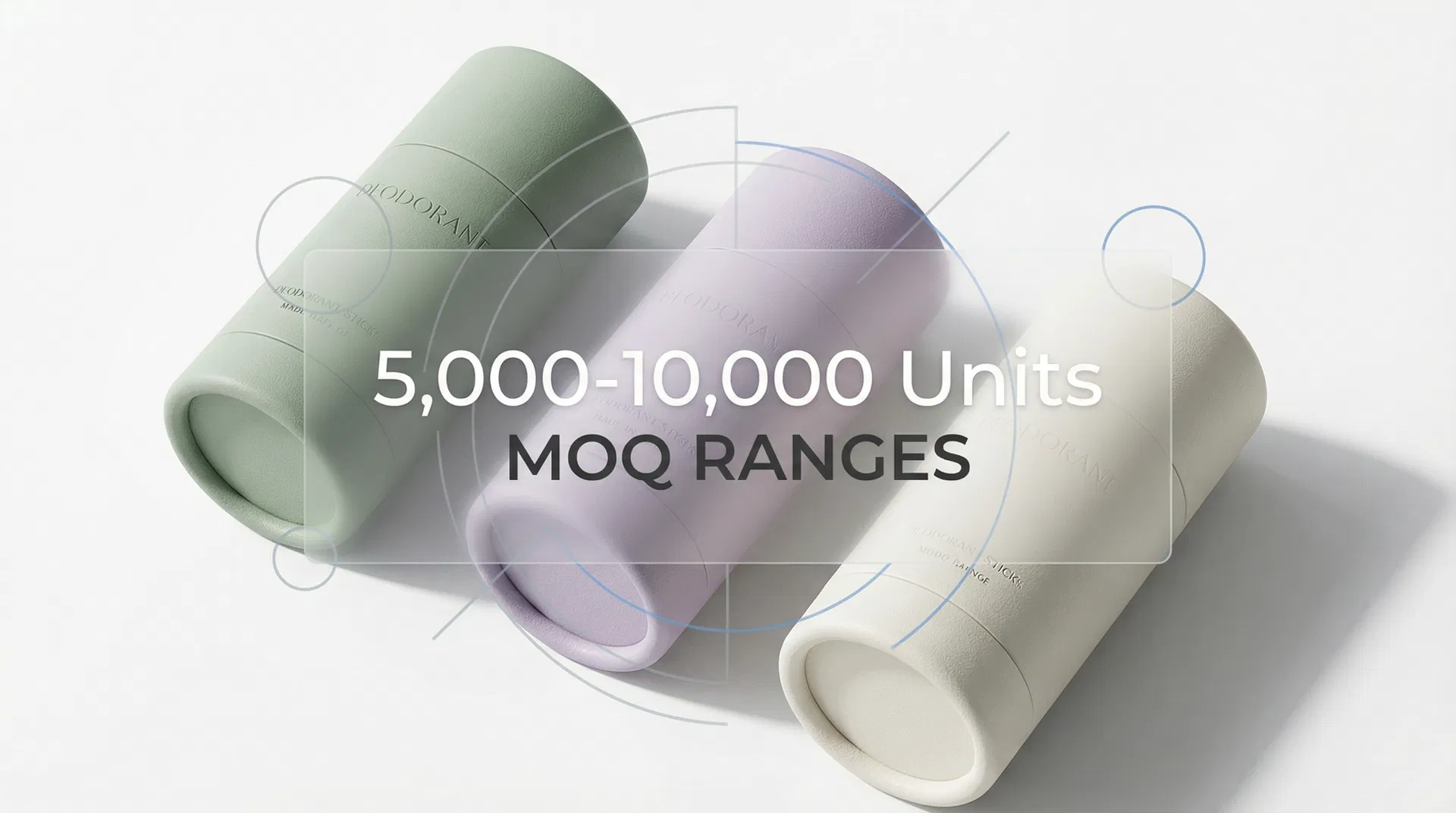
| Deodorant Sticks | 5,000 - 10,000 units | $2 - $4 | $10,000 - $40,000 | 3-5 weeks |
| Lip Balms & Lip Care | 5,000 - 10,000 units | $1 - $3 | $5,000 - $30,000 | 3-4 weeks |
Factors That Affect MOQ
1. Manufacturing Process Complexity
Products requiring specialized equipment or multi-step processes typically have higher MOQs. For example, sunscreen manufacturing requires SPF testing equipment and stability chambers, leading to higher MOQs (3,000-5,000 units) compared to simple body lotions.
2. Packaging Type
Custom packaging significantly impacts MOQ. Stock packaging (generic bottles and jars) allows MOQs as low as 1,000-2,000 units. Custom molds for unique bottle shapes require MOQs of 10,000-50,000 units due to tooling costs ($3,000-$15,000).
| Packaging Type | MOQ Range | Tooling Cost | Lead Time |
|---|---|---|---|
| Stock Packaging | 1,000 - 2,000 units | $0 | 2-3 weeks |
| Custom Labels Only | 2,000 - 3,000 units | $200 - $500 | 3-4 weeks |
| Custom Printing on Stock | 3,000 - 5,000 units | $500 - $1,500 | 4-5 weeks |
| Custom Mold (New Shape) | 10,000 - 50,000 units | $3,000 - $15,000 | 8-12 weeks |
3. Ingredient Sourcing
Premium or rare ingredients often have their own MOQs from suppliers. Organic argan oil, for instance, may require a 25kg minimum order. If your formulation uses 5% argan oil and each unit contains 50ml, you can calculate the minimum production quantity needed to use the entire ingredient order.
4. Certification Requirements
Products requiring certifications (organic, vegan, cruelty-free) may have higher MOQs because certified ingredients come in larger minimum quantities. Organic certification also adds 15-25% to ingredient costs.
How to Negotiate Lower MOQs
Strategy 1: Multi-Product Orders
Manufacturers are more flexible when you order multiple products. Instead of 5,000 units of one cream, order 2,500 units each of two different formulations. This maintains the manufacturer's total production volume while reducing your per-SKU risk.
Strategy 2: Flexible Packaging
Accept stock packaging for your first order. Once you validate market demand, invest in custom packaging for reorders. This reduces initial MOQ from 10,000 to 2,000-3,000 units.
Strategy 3: Longer Lead Times
Manufacturers can consolidate your order with others if you accept longer production timelines (8-12 weeks instead of 4-6 weeks). This allows them to optimize raw material procurement and reduce their per-unit costs, making lower MOQs viable.
Strategy 4: Prepayment or Deposit
Offering 50-70% prepayment instead of the standard 30% deposit reduces the manufacturer's financial risk, making them more willing to accept lower MOQs.
MOQ vs. Production Efficiency
While negotiating the lowest possible MOQ is tempting, there's a sweet spot where production efficiency maximizes value. Manufacturing costs decrease significantly at certain volume thresholds:
| Order Quantity | Cost per Unit | Total Cost | Cost Savings vs. MOQ |
|---|---|---|---|
| 3,000 units (MOQ) | $5.00 | $15,000 | Baseline |
| 5,000 units | $4.50 | $22,500 | 10% savings per unit |
| 10,000 units | $4.00 | $40,000 | 20% savings per unit |
| 20,000 units | $3.70 | $74,000 | 26% savings per unit |
The optimal order quantity depends on your sales velocity. If you sell 500 units per month, a 5,000-unit order provides a 10-month supply—manageable inventory turnover. A 20,000-unit order would take 40 months to sell, tying up capital and risking product expiration.
MOQ for Different Business Models
Startup Brands (Testing Phase)
Recommended MOQ: 1,000-3,000 units
Strategy: Use stock packaging, test 2-3 formulations, focus on market validation
Investment: $5,000-$15,000
Timeline: 6-8 weeks
Growing Brands (Scaling Phase)
Recommended MOQ: 5,000-10,000 units
Strategy: Custom labels, proven formulations, optimize cost per unit
Investment: $20,000-$50,000
Timeline: 8-10 weeks
Established Brands (Optimization Phase)
Recommended MOQ: 10,000-50,000 units
Strategy: Full custom packaging, multiple SKUs, maximum cost efficiency
Investment: $50,000-$200,000
Timeline: 10-14 weeks
Hidden Costs Beyond MOQ
MOQ is just one component of your total investment. Factor in these additional costs:
- Tooling & Molds: $3,000-$15,000 for custom packaging
- Product Testing: $2,000-$5,000 for stability, microbiology, and safety testing
- Certifications: $1,500-$5,000 for organic, vegan, or cruelty-free certifications
- Shipping & Logistics: 10-15% of product cost for international shipping
- Import Duties & Taxes: 5-10% of product value (varies by country)
- Warehousing: $200-$500/month for 5,000-10,000 units
MOQ Trends in 2025
The skincare manufacturing landscape is evolving, with several trends affecting MOQ requirements:
Micro-Batch Manufacturing: New manufacturers specializing in small-batch production offer MOQs as low as 500-1,000 units, but at 20-30% higher per-unit costs.
Digital Printing: On-demand digital label printing reduces MOQs for custom packaging from 5,000 to 1,000 units, though at $0.50-$1.00 higher per label.
Ingredient Pre-Purchasing: Some manufacturers now offer "ingredient banks" where multiple brands share bulk ingredient orders, reducing individual MOQs by 30-40%.
Flexible Manufacturing Networks: Platforms connecting brands with multiple manufacturers allow order splitting—2,000 units from Factory A, 3,000 from Factory B—effectively lowering per-product MOQs.
Questions to Ask Your Manufacturer
Before committing to an MOQ, clarify these critical points:
- What is your absolute minimum MOQ, and what is your recommended MOQ for cost efficiency?
- Can I split the MOQ across multiple formulations or scents?
- What are the MOQ differences between stock and custom packaging?
- Do you offer MOQ reductions for multi-product orders or long-term contracts?
- What is the cost per unit at MOQ vs. 2x MOQ vs. 5x MOQ?
- Are there ingredient minimum orders that affect my product MOQ?
- What happens if I need to reorder below MOQ in the future?
- Can I increase my order quantity after initial agreement but before production?
Case Study: Optimizing MOQ for a New Brand
Scenario: A startup brand wants to launch a natural deodorant line with three scents.
Option 1 - High MOQ:
Order 10,000 units of each scent (30,000 total)
Cost: $2.50/unit = $75,000
Risk: 30,000 units to sell, 18-24 month inventory
Option 2 - Optimized MOQ:
Order 3,000 units of each scent (9,000 total)
Cost: $3.00/unit = $27,000
Benefit: Test market demand, 6-8 month inventory, $48,000 capital saved
Outcome: The brand chose Option 2. After 6 months, lavender sold out while mint moved slowly. They reordered 5,000 lavender units at $2.70/unit (lower cost due to proven demand) and discontinued mint, avoiding $25,000 in dead inventory.
Conclusion: Finding Your MOQ Sweet Spot
The right MOQ balances three factors: capital efficiency, inventory risk, and cost per unit. For most new skincare brands, starting with 3,000-5,000 units using stock packaging provides the best risk-reward ratio. As you validate demand and optimize your formulation, scale to 10,000-20,000 units with custom packaging to maximize profitability.
Remember: MOQ is negotiable. Manufacturers want long-term partnerships, not one-time orders. Demonstrate your commitment to growth, offer reasonable payment terms, and be flexible on timelines to secure favorable MOQ terms.
Ready to Start Your Skincare Brand?
At MEIMISHI, we specialize in flexible MOQ solutions for emerging skincare brands. Our MOQs start at 3,000 units with stock packaging, and we offer multi-product discounts to help you test multiple formulations without excessive capital requirements.
Contact us today for a free MOQ consultation and custom quote.
Email: [email protected]
Phone: +86 139 2226 7562
WhatsApp: +86 139 2226 7562